Article
Jul 4, 2026
Voice AI for Gas Station Chains: Automate Customer Service, Win More Fleet Accounts, and Scale Across Every Location
Gas station chains handle millions of loyalty program calls, fleet account queries, and EV charging inquiries every year. Voice AI automates all of it 24/7 at a fraction of the cost. Here is how.
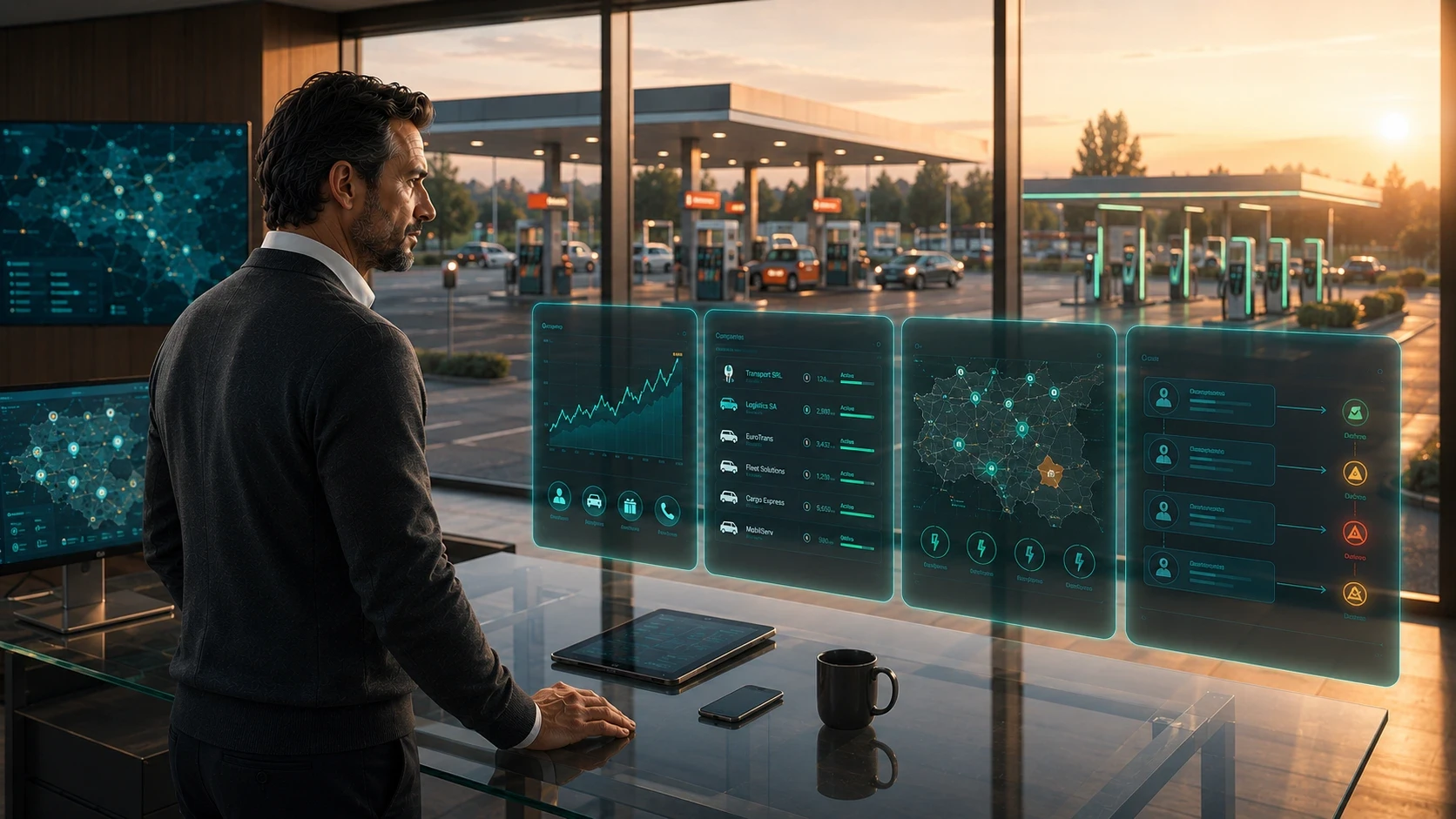
Article Summary: This article explains why large fuel retail chains face a genuinely two-sided customer service challenge - managing high-volume consumer loyalty calls simultaneously with high-value fleet and B2B account queries - and how Voice AI and workflow automation address both at scale. It maps seven distinct fuel retail call types across consumer and fleet segments, models the annual cost deflection opportunity for a large network, and presents a realistic scenario based on one of Romania's largest fuel retail operators, which already operates over 1,250 retail points in Romania and has committed to digitizing customer interaction as a core strategic direction. Includes a consumer vs. fleet comparison table, call type triage table, cost deflection model, full comparison table, and implementation guidance.
Key Highlights
• Fuel retail chains are unusual among the industries covered in this series because they operate at the intersection of mass-market consumer services and high-value B2B fleet account management - and both sides call the same central customer service operation.
• Loyalty program calls are among the highest-volume, most repetitive, and most automatable call types any fuel retailer handles. A network with millions of loyalty members generates an enormous, largely routine inquiry volume.
• Fleet and B2B account management calls carry a different kind of risk when missed or handled poorly: a logistics company managing hundreds of vehicles that cannot get a billing issue resolved quickly may take their fuel contract to a competing network.
• EV charging is creating a rapidly growing new category of customer inquiry - charging station location, connector compatibility, billing support - that most fuel retail contact centers are not yet equipped to handle at scale.
• When fuel prices move significantly, contact centers receive a surge of inbound calls asking about current prices, price components, and the impact on fleet contracts. Voice AI absorbs this surge without hold time increases or staffing changes.
• A large fuel retail chain that already uses AI in its operations systems gains a natural adjacent capability when Voice AI is added to the customer-facing communication layer - the two work best together, not in isolation.
• Multilingual support is directly relevant for fuel retail chains operating across multiple countries with different primary languages, or in regions with minority language populations.
Table of Contents
• Why Fuel Retail Chains Have a Two-Sided Customer Service Problem
• The Two Types of Callers Every Fuel Retail Chain Serves
• The Fuel Price Surge Call Wall
• The Seven Types of Inbound Calls Every Fuel Retail Chain Handles
• The Cost Deflection Opportunity at Fuel Retail Scale
• 7 Ways Voice AI and Workflow Automation Transform Fuel Retail Operations
• Case Study: A Leading Fuel Retail Chain Across Romania and the Black Sea Region
• Traditional Call Center vs. AI Phone Agent: Side-by-Side Comparison
• How to Implement Voice AI at a Gas Station Chain
• Common Mistakes Fuel Retail Chains Make with Customer Communication
• Best Practices for Fuel Retail Voice AI
• Future Trends: AI in Fuel Retail and Mobility Services
• Frequently Asked Questions
• Conclusion
Introduction
A fleet manager at a Romanian transport company is trying to reach the customer service line for their corporate fuel account. Three trucks reported a blocked fleet card this morning. The drivers are sitting at a station, unable to fuel. The manager has called twice. Both times, the call was answered on hold and eventually dropped.
Meanwhile, on the same customer service line, a private motorist is asking about a missing loyalty points credit from last week's fill-up. Two more are asking about the nearest station with an EV charger fast enough for their car. And another is calling to complain about a car wash machine that damaged their wing mirror.
All of these calls arrived within the same twenty-minute window. One of them - the fleet manager - represents a contract worth several thousand euros a month. And right now, they are sitting in a queue alongside a loyalty points dispute and a car wash complaint, being handled by the same finite number of agents.
This is the central challenge of customer service at a large fuel retail chain. The contact center is simultaneously a high-volume consumer helpline, a B2B account support function, a technical support desk for new EV charging infrastructure, and the intake point for complaints, franchise inquiries, and partnership proposals. All of it flows through the same phone number.
This article explains how Voice AI and workflow automation separate these call streams, handle the routine majority automatically, and ensure the high-value fleet calls reach the right person immediately - without a queue, and without competing with the loyalty points inquiry happening on the next line.
Why Fuel Retail Chains Have a Two-Sided Customer Service Problem
Most businesses in this series serve one type of caller in one kind of relationship. A dental clinic serves patients. A law firm serves clients. A restaurant serves diners. A fuel retail chain is different - it serves two structurally distinct caller populations with different needs, different expectations, and very different consequences when they are not served well.
The consumer side is defined by volume. A network with millions of loyalty program members will generate an enormous flow of inbound calls - balance inquiries, missing points claims, EV charging location requests, complaint submissions - that is largely predictable, largely routine, and largely structured enough to be automated.
The fleet and B2B side is defined by value. A logistics company managing a fleet of 200 vehicles filling up daily represents a fuel contract worth potentially hundreds of thousands of euros per year. When a fleet manager calls to resolve a blocked card or dispute an invoice, the quality and speed of that interaction has a direct relationship with the durability of the contract. A fleet manager who cannot get a routine billing issue resolved quickly does not stay frustrated indefinitely - they escalate it to a contract review.
Both sides call the same number. Both deserve excellent service. And the practical challenge is that the routine consumer volume, if unmanaged, drowns the contact center's capacity to give fleet calls the immediate, focused attention they deserve.
The Two Types of Callers Every Fuel Retail Chain Serves
Understanding how these two caller populations differ is the foundation for designing an effective AI-assisted call handling system. The table below contrasts their key characteristics.
Dimension | Consumer Caller | Fleet / B2B Caller |
Who Calls | Individual driver, loyalty program member, private motorist | Fleet manager, logistics company, transport operator, corporate account holder |
Typical Call Reason | Loyalty points balance, missing points, EV charging location, station hours, complaint | Invoice query, fleet card management, account statement, bulk pricing, card blocked |
Call Volume | Very high - spans millions of loyalty program members | Medium but high-value - each account may represent a contract worth tens of thousands of euros annually |
Cost of Missed Call | Low to medium per call - consumer will eventually reach self-service or call back | High - a fleet manager unable to resolve an issue may escalate the contract review or switch provider |
AI Automation Suitability | Very high - balance inquiries, station finders, EV support, complaint logging are all structured | High for routine queries (statements, invoices); human needed for contract renegotiation or credit limit changes |
The most important row in this table is the last one. Both caller types have a high share of queries that Voice AI can handle fully, but the automation opportunity looks different for each. For consumers, the goal is cost deflection: handling millions of routine loyalty and location queries without agent time. For fleet accounts, the goal is speed and quality: ensuring that routine account queries - the ones an AI can genuinely resolve - are answered instantly, so that the truly complex fleet issues reach a human account manager without competing for queue position with a loyalty balance check.
The Fuel Price Surge Call Wall
Like electricity providers and large utilities, fuel retail chains face a predictable category of call surge that is distinct from normal volume fluctuations: the fuel price change event. When fuel prices move significantly - because of crude oil market movements, tax changes, or regional supply disruptions - both consumers and fleet managers call the contact center in elevated numbers.
Consumer callers want to know the current price at their nearest station before deciding whether to fill up now or wait. Fleet managers want to understand the impact on their fuel spend and, in some cases, whether their contracted pricing includes a ceiling or adjustment mechanism.
This surge is not as extreme as a storm event at an electricity provider, but it can sustain elevated call volumes for days or weeks during periods of significant price movement. Voice AI handles this surge by providing current prices directly from the live pricing system - accurately, consistently, and without hold time - for every consumer caller, while routing fleet pricing enquiries that require contractual discussion directly to the account team.
During periods of sustained price change, having the same approved explanation of price components and current pricing delivered consistently to every caller - regardless of which agent is available - also prevents the kind of inconsistent messaging that erodes customer trust when callers compare notes and find they received different information.
The Seven Types of Inbound Calls Every Fuel Retail Chain Handles
Fuel retail customer service calls follow a consistent taxonomy across both the consumer and fleet segments. The table below maps the seven most common types against their caller segment and AI handling protocol.
Call Type | Caller Segment | AI Phone Agent Handles | Routes to Human Agent When |
Loyalty Program Support | Consumer - Very High Volume | Confirms points balance, explains redemption options, logs missing points claims, explains tier status and benefits | Member disputes a significant transaction, requests account closure, or raises a fraud concern |
Fleet Card and Account Management | Fleet / B2B - High Value | Provides account balance, last statement summary, card status checks, and recent transaction overview from the fleet management system | Fleet manager requests a credit limit change, reports a card lost or compromised, or has a billing dispute requiring account team authorization |
EV Charging Support | Consumer - Fast-Growing | Confirms nearest stations with EV charging, available connector types and speeds, in-app payment guidance, and current availability status | Caller reports a charger fault, a billing error on a charging session, or needs a refund for an incomplete session |
Station Locator and Services FAQ | Consumer - High Volume, Routine | Identifies nearest stations with specific services (LPG, car wash, restaurant, 24h opening) from the station directory; answers hours and contact queries instantly | Essentially never - this call type is fully self-contained |
Fuel Price Inquiry | Consumer + Fleet - High During Price Changes | Provides current fuel prices at requested locations from the live pricing system; answers general questions about price components and premium fuel differences | Fleet manager requests a contractual pricing review or negotiation, which requires account manager involvement |
Complaint and Quality Issue | Consumer + Fleet - Medium Volume | Captures the complaint details, reference station, date, and nature of the issue; logs it with a ticket number and confirms the resolution timeline to the caller | Complaint involves a fuel quality issue with potential vehicle damage, a safety incident at a station, or an issue the caller is escalating to a regulator |
Franchise and Partnership Inquiry | B2B - Medium Volume, High Potential Value | Captures the caller's company, interest area (franchise, supplier, partnership), and contact details; routes to the relevant business development contact with full context | Always - franchise agreements and B2B partnerships require direct engagement with business development leadership |
The seven call types in this table divide naturally into two groups. Four of them - loyalty program support, station locator and services, fuel price inquiries, and complaint logging - are primarily consumer-facing, high-volume, and largely routine. Three - fleet account management, EV charging support, and franchise and partnership inquiries - require faster, higher-quality handling either because of their commercial value or their growing strategic importance. A well-configured Voice AI system treats these two groups differently, not because one is more important than the other, but because the nature of what excellent service looks like differs substantially between them.
The Cost Deflection Opportunity at Fuel Retail Scale
For a large fuel retail chain, as for utility companies, the primary financial case for Voice AI is cost deflection rather than revenue capture. The contact center is primarily a cost center, and reducing the cost per interaction on routine calls at scale produces a compounding financial benefit.
The table below illustrates the potential annual cost deflection for a large fuel retail network. All figures are illustrative and should be replaced with actual call volume and handling cost data for a network-specific calculation.
Metric | Calculation (Illustrative) | Result |
Estimated monthly call volume (large network) | 120,000 calls (consumer + fleet combined) | 120,000 calls |
Share of routine, automatable calls | 70% (loyalty, station FAQ, EV support, price inquiries) | 84,000 calls |
AI automation success rate | 80% of automatable calls fully resolved | 67,200 calls/month deflected |
Estimated cost per human-handled call | €4.50 (blended, illustrative) | — |
Monthly cost deflection | 67,200 x €4.50 | €302,400/month |
Annual cost deflection | €302,400 x 12 | €3,628,800/year |
Fleet account retention value (additional) | Faster fleet query resolution reduces risk of account churn to competitor networks | Not modelled - qualitative benefit |
Note: All figures in this table are illustrative planning estimates. Call volumes, automation rates, and cost per call vary significantly by network size, geographic market, contact center staffing model, and existing technology infrastructure. €4.50 is a conservative blended estimate for cost per human-handled call in a European fuel retail contact center context. Networks should derive their own figures from actual operational data.
The annual figure above is a baseline estimate covering only the direct cost deflection benefit from automating routine call types. It does not include the qualitative value of faster fleet account resolution, reduced customer churn from better service quality, or the competitive advantage of 24/7 customer availability in markets where competing networks are not yet offering this capability.
7 Ways Voice AI and Workflow Automation Transform Fuel Retail Operations
Here is exactly what a properly configured Voice AI and workflow automation system delivers across the seven highest-impact use cases for a gas station chain.
1. Loyalty Program Support at Scale
Loyalty programs are the primary vehicle through which fuel retail chains build consumer relationships and reduce price-driven switching. A successful loyalty program can have millions of active members - and millions of members generate an enormous volume of inbound support calls. Balance inquiries, missing points claims, tier benefit questions, redemption process questions, and app support queries all flow to the same contact center.
An AI phone agent integrated with the loyalty platform answers balance inquiries instantly, explains redemption options and tier benefits from the pre-approved knowledge base, and captures missing points claims with the required detail - station, date, transaction amount, receipt reference - before logging them as a claim ticket. The claim is reviewed by a human agent on their own timeline, without the customer needing to be held on the line while that review happens.
For a network with an active digital loyalty program and payment app, the AI can also answer questions about the app itself - how to link a card, how points are awarded for different purchase types, how to use the app for contactless payment - relieving the contact center of what is often one of its fastest-growing call type categories as digital adoption increases.
2. Fleet and B2B Account Management Support
Fleet account support is the single highest-value call type a fuel retail contact center handles, and it is also the one where poor service quality has the most direct commercial consequence. A logistics company whose fleet manager cannot quickly resolve a blocked card, retrieve a billing statement, or check the remaining credit on an account is experiencing a service failure that goes directly into the next contract review conversation.
An AI phone agent integrated with the fleet management system handles the routine majority of fleet account calls without any human agent involvement. The caller identifies their account, and the AI provides current card status, account balance, recent transaction summary, and statement retrieval options - in real time, without a queue, at any hour. For card block emergencies - which do happen outside business hours when a driver is stranded at a station - the AI can initiate the emergency unlock process and alert the account manager simultaneously.
For queries that require authorization or account-level decisions - credit limit changes, disputed invoice resolutions, contract pricing discussions - the AI captures the full context of the query and routes it to the account manager with everything needed to resolve it in a single follow-up call.
3. EV Charging Support and Station Routing
Electric vehicle charging at fuel station networks is a rapidly growing service category, and one that is generating a new call type that most fuel retail contact centers are only beginning to encounter at meaningful scale. Drivers calling to find the nearest charging station with a compatible connector, understand the charging speeds available, troubleshoot an app payment issue, or dispute a billing error on a charging session are a new and growing caller segment.
An AI phone agent configured with the current station directory and charging infrastructure data handles the routine end of this spectrum immediately. It can identify the nearest stations with the caller's required connector type, provide current charging speeds and estimated times for different vehicle battery sizes, and explain the app-based payment process step by step.
For fault reports - a charger that is not working, a session that did not complete correctly - the AI logs the report with station location, charger ID, and session time, and routes it to the technical team. For billing disputes on charging sessions, the AI captures the session details and initiates the dispute process, flagging the case for review while providing the caller with a reference number and expected resolution timeline.
4. Station Locator and Services Directory
"Where is the nearest station that also has LPG?" and "Is the station on the A1 highway near Sibiu open at 2 AM?" are questions that any large fuel retail network's contact center receives constantly, and they have exact, lookable answers in a station directory. There is no judgment required. There is no complexity. And yet they consume agent time on every call.
An AI phone agent with access to the live station directory answers these questions instantly and accurately, across any station in the network. It can filter by service type - LPG, car wash, EV charging, restaurant, 24-hour operation - and provide address, opening hours, and contact details without any human involvement. For multi-country networks, it can do this in the appropriate language for the caller's location.
5. Fuel Price Inquiry Handling During Surge Periods
As described earlier, periods of significant fuel price movement generate an elevated wave of inbound calls from both consumers checking prices before fueling and fleet managers assessing the impact on their fuel spend. An AI phone agent provides current prices directly from the live pricing system - accurately, at any hour, without a queue - for any station in the network.
During a sustained price change period, this capability means every caller receives the same current, approved price information, with no risk of inconsistency between different agents' knowledge or different points in the day when prices have been updated. For fleet managers whose query moves beyond current prices into contractual pricing implications, the AI captures the nature of the request and routes it to the account manager with full context.
6. Complaint and Quality Issue Intake
Complaint calls are an important part of any customer service operation - they surface real service quality issues, fuel quality concerns, and equipment problems that the network needs to know about. They are also calls that frequently require structured information capture: which station, which pump, which date and time, what specifically happened, what the customer wants as a resolution.
An AI phone agent handles the intake phase of complaint calls by collecting all of this structured information in a single, efficient call and issuing a complaint reference number before the call ends. The customer knows their complaint is logged and has a reference. The complaints team reviews and resolves the case on their own timeline, without needing to call the customer back just to gather the basic information that should have been captured at intake.
For complaints involving potential safety issues - a suspected fuel quality problem that may have caused vehicle damage, a safety incident at a station, or any concern the caller is considering escalating to a regulator - the AI flags the case as priority and routes it for same-day human review rather than standard queue processing.
7. Franchise and Partnership Inquiry Routing
Large fuel retail networks actively expand through franchise partnerships - independent filling station operators who join the network, operate under the brand's standards, and source fuel from the group's refinery. Potential franchise partners often make first contact by phone, as do potential suppliers, B2B technology partners, and other commercial relationship prospects.
These calls frequently get lost in the general customer service queue during busy periods, handled by whichever agent happens to answer, with inconsistent information capture and no reliable routing to the relevant business development contact. An AI phone agent captures the caller's company, the nature of their interest, their contact details, and their preferred timeframe, then routes the inquiry directly to the business development team with a structured brief - rather than relying on a customer service agent's memory or a hand-scrawled message slip.
Case Study: A Leading Fuel Retail Chain Across Romania and the Black Sea Region
About this case study: The scenario below is based on publicly available information about a major fuel retail operator in Romania and the Black Sea region. The company operates over 1,250 fuel retail points in Romania and more than 1,400 sales points across Europe, and has publicly stated that digitizing customer interaction is one of its three strategic retail priorities. The company has also already deployed an IT system using artificial intelligence, blockchain, and machine learning across approximately 500 stations in Romania, with a planned rollout across its international network. All specific call volumes, cost figures, and outcomes described below are illustrative, not verified statements about the company's actual customer service operations.
Company profile: The company is one of Romania's largest fuel retail operators, with a network of over 1,250 retail points in Romania operating under its own brand and through franchise partnerships. It has significant EV charging infrastructure - currently 139 charging points across 31 stations in Romania - and operates the largest LPG distribution network in the country. The company also operates a fleet management system covering both Romania and Bulgaria, serving logistics, transport, and corporate fleet customers. Its in-station food and beverage brand operates across the network, with three distinct service lines for different customer occasions. Internationally, the company operates stations in Moldova (96 stations), Bulgaria (57 stations), and Georgia (82 stations).
Strategic context: The company has publicly identified three strategic pillars for its retail division: expanding the station network, strengthening in-station retail and food services, and digitizing customer interaction. On the digital front, it has already deployed a new IT system across approximately 500 Romanian stations - a system that explicitly incorporates AI, blockchain, and machine learning for operational processes including POS management, loyalty program integration, payments, and real-time data integration. The company's consumer loyalty app has a high adoption rate, which the company itself cites as evidence of its customers' appetite for technology-integrated daily routines. This technology posture makes Voice AI a natural adjacent investment - complementing the operational AI already in place with a customer-facing communication layer.
The customer service challenge (illustrative):
• The company's loyalty program serves a large consumer base across its Romanian network, generating a high and growing volume of inbound calls for balance checks, missing points claims, and app-related queries as digital adoption increases
• The Fill&Go fleet management system serves logistics and transport companies across Romania and Bulgaria, with fleet managers needing responsive support for card management, account statements, and billing queries - particularly during the month-end billing cycle and whenever fuel prices move sharply
• The company's 139 EV charging points across 31 stations represent a fast-growing service category generating new call types - station location, charging speed queries, app payment support, and fault reports - that require routing to a separate technical team rather than a general customer service agent
• With over 1,250 retail points across Romania operating under a mix of company-owned and franchise formats, the station locator and services call type generates very high volume from customers trying to find the nearest station with a specific combination of services
• The company's multilingual footprint - serving Romanian and Hungarian-speaking customers in Transylvania, Bulgarian customers through its Bulgarian subsidiary, and Moldovan customers through its Moldova operations - creates a real need for multilingual customer service capability
The Voice AI scenario: In this illustrative scenario, a Voice AI deployment configured for the company's specific call mix would: handle consumer loyalty program calls and station locator queries fully automatically in Romanian and Hungarian; provide real-time account status to fleet managers calling about their Fill&Go accounts, with emergency card issues escalated immediately regardless of hour; answer EV charging location and payment queries from the station directory and route fault reports to the technical team; and capture all complaints with structured ticket creation before the call ends. The system would integrate with the company's existing retail IT platform - working alongside the AI already embedded in that system - rather than replacing any operational infrastructure.
Illustrative outcomes of this configuration:
• Consumer loyalty call automation: The large volume of routine balance inquiries and station locator calls handled without human agent involvement, freeing the contact team for the cases that actually require judgment
• Fleet account emergency coverage: Fill&Go fleet managers receive 24/7 immediate account status and emergency card support regardless of when they call, reducing the risk of fleet contract churn from poor after-hours service
• EV charging inquiry routing: Growing EV support call volume handled by AI for the location and information tier, with fault reports routed to the technical team with structured logging rather than reaching a general agent who may not have the information to resolve it
• Multilingual network coverage: Romanian and Hungarian consumer calls handled in the caller's preferred language across the Romanian network; structured for future extension to Bulgarian and Moldovan operations as those networks scale
• Complaint documentation quality: Every complaint call results in a complete, structured ticket with all required fields, reducing the need for follow-up calls to collect information that should have been gathered at intake
All call volumes, cost figures, and outcome estimates in this case study are illustrative. They are not verified statements about the company's actual customer service operations, technology infrastructure, or financial performance. The company profile facts cited are drawn from the company's publicly available official website. This scenario is presented as a realistic planning framework for a fuel retail network of comparable scale, service mix, and digital strategy.
Traditional Call Center vs. AI Phone Agent: Side-by-Side Comparison
Function | Traditional Call Center | AI Phone Agent |
Call Hours | Business hours; overnight and weekend coverage limited | 24/7 including nights, weekends, and public holidays |
Loyalty Program Balance Inquiries | Manual account lookup per call | Instant, directly from loyalty system |
Fleet Account Status Checks | Agent accesses fleet system manually | Real-time pull from fleet management platform |
EV Charging Station Finder | Agent searches station list manually | AI queries live station directory with connector and availability filters |
Fuel Price Surge Call Handling | Hold times increase; consistent messaging at risk | All callers answered instantly with the same approved messaging |
Complaint Logging Consistency | Varies by agent; risk of incomplete records | Structured, complete record on every call |
Multilingual Consumer Support | Limited to available bilingual staff | 100+ languages including Romanian and Hungarian |
Franchise Inquiry Capture | Often missed or poorly documented during busy periods | Fully captured and routed with structured detail |
Cost per Routine Call | Full agent cost regardless of call complexity | Fraction of agent cost for deflected calls |
How to Implement Voice AI at a Gas Station Chain
Implementation at a multi-country fuel retail network has several dimensions not present in smaller deployments. Here is a step-by-step guide calibrated for a large network with both consumer and fleet caller populations.
Step 1: Segment your call volume by type and caller population. Analyse three to six months of contact center data to understand the actual breakdown by call type, whether the caller is a consumer loyalty member or a fleet account, and what the current handling time and cost per call looks like for each type. This baseline determines where the cost deflection opportunity is largest.
Step 2: Define the integration architecture. Voice AI at a fuel retail chain requires integration with at least three back-end systems: the loyalty platform (for consumer inquiries), the fleet management system (for B2B account queries), and the station directory (for location and services queries). An optional fourth integration - the live pricing system - enables real-time price information during surge periods. Define the technical scope of each integration before vendor selection.
Step 3: Build separate call flows for consumer and fleet callers. Consumer and fleet callers should be routed into different AI conversation flows from the moment the call is answered, not treated with the same generic intake. The opening question or IVR selection should separate them cleanly, because the qualifying questions, information lookups, and escalation logic are fundamentally different for each group.
Step 4: Configure the fleet emergency protocol. Fleet card emergencies - blocked cards, drivers unable to fuel, account issues with immediate operational impact - must have a defined escalation pathway that operates 24/7. Configure this pathway to alert the on-call account manager and offer the fleet manager an immediate callback commitment, not a message that will be reviewed during business hours.
Step 5: Implement multilingual support for your network geographies. For networks operating across multiple countries or serving regions with significant minority language populations, configure language support for every language spoken by a meaningful share of your customer base. For a Romanian network with Transylvanian operations, this means Romanian and Hungarian as a minimum.
Step 6: Define complaint escalation triggers. Not all complaints are equal. Fuel quality complaints with potential vehicle damage implications, safety incidents at stations, and complaints where the caller indicates regulatory escalation intent all require same-day human review, not standard queue treatment. Define these escalation triggers explicitly and test them before go-live.
Step 7: Test across all call types with real product and service scenarios. Before going live, run the AI through the full range of realistic call scenarios for your specific network - including loyalty program edge cases, fleet card emergency simulations, EV charging fault reports, and franchise inquiry calls. Identify any gaps in the configuration before real customers encounter them.
Step 8: Plan for ongoing knowledge base maintenance. Station directories change as new stations open or close. Pricing updates require rapid propagation. Loyalty program terms are periodically revised. Fleet account structures are updated seasonally. Build a maintenance process into the deployment from day one, rather than treating go-live as the end of the configuration work.
Common Mistakes Fuel Retail Chains Make with Customer Communication
These are the most common errors large fuel retail networks make when approaching customer service automation.
Treating consumer and fleet callers with the same generic call flow. A loyalty balance inquiry and a fleet card emergency require fundamentally different handling. Routing both into the same generic IVR and call flow produces an experience that is adequately poor for both, rather than excellent for either.
Not integrating the AI with the fleet management system. An AI phone agent for fleet account support that cannot access the actual fleet account data in real time is not solving the fleet manager's problem - it is just taking a message. Fleet management system integration is not optional for this call type.
Deploying EV support with static station data. EV charging availability changes throughout the day as chargers are in use, faulted, or under maintenance. An AI providing static charger availability information will direct drivers to stations where charging is unavailable, creating exactly the frustrating experience the system was meant to prevent.
Not defining an after-hours fleet emergency pathway. Fleet operations do not stop at 5 PM. A blocked fleet card at 11 PM on a Sunday has exactly the same commercial urgency as one at 10 AM on a Tuesday. If the AI cannot escalate fleet emergencies to an on-call contact outside business hours, it is not serving the fleet customer segment adequately.
Launching without testing the complaint escalation logic. A fuel quality complaint that causes vehicle damage, if mishandled at first contact, creates liability and regulatory exposure for the network. Complaint escalation triggers must be tested explicitly before go-live, not assumed to be working correctly based on the general configuration.
Best Practices for Fuel Retail Voice AI
These practices consistently improve outcomes for fuel retail networks implementing Voice AI:
• Separate consumer and fleet calls at the first interaction. Use the opening of the call to identify whether the caller is a consumer loyalty member or a fleet account holder. From that point, everything about the conversation - the questions asked, the system accessed, the escalation logic - should be tailored to that caller type.
• Treat the fleet account manager as a VIP caller, not a queue position. Configure your system so fleet account calls from registered account holders receive immediate AI service with no queue, and that escalations to human account managers come with a committed response time.
• Update the station directory and pricing system integration immediately when network changes occur. A caller directed to a station that no longer has LPG or whose EV chargers are offline is worse than a caller who never got an answer. Directory accuracy is the foundation of the station locator use case.
• Use AI-captured complaint data to identify systemic station-level issues. When the AI logs complaints, patterns emerge: multiple complaints about the same station's car wash, recurring fuel quality reports from the same pump, or a cluster of payment terminal complaints at a specific location. This data should flow into station operations review.
• Set a maximum response time for fleet emergency escalations and measure it. Define, measure, and report the time from an AI-identified fleet emergency flag to a human account manager's first contact with the caller. This metric should be part of the account manager team's performance framework, not just an operational target.
Future Trends: AI in Fuel Retail and Mobility Services
The fuel retail industry is in the middle of a long-term structural transition driven by electrification, alternative fuels, and the evolution of gas stations into integrated mobility and service hubs. These changes are creating new categories of customer interaction that will require AI support to manage at scale.
Proactive loyalty engagement through outbound AI calls. Rather than waiting for loyalty members to call about unclaimed points or expiring rewards, AI systems will proactively contact members with personalized reminders, offers, and redemption prompts - turning the call center from a reactive inquiry handler into an active loyalty engagement channel.
AI-assisted fleet account relationship management. Beyond inbound support, AI will conduct periodic outbound calls to fleet account managers - month-end spend summaries, contract renewal reminders, and new service notifications - maintaining the account relationship between renewal cycles without consuming human account manager time.
EV charging smart routing and session management. As EV charging becomes a major service category, AI will move beyond answering charging location queries to actively managing the session experience - confirming charging has started, providing estimated completion times, and proactively notifying drivers of any session interruptions.
Alternative fuel and hydrogen support. As networks expand into LPG, CNG, and eventually hydrogen fueling, each new fuel type creates a new category of customer education and support call. AI systems that can explain how to use hydrogen fueling infrastructure, which vehicles are compatible, and where the nearest station is located will be valuable before mass market adoption makes these questions less frequent.
Cross-border account management for regional fleets. For fuel retail networks operating across multiple countries - Romania, Bulgaria, Moldova, Georgia, and beyond - fleet managers running cross-border logistics operations will increasingly expect seamless account management across the whole network. AI systems that can handle multi-country account queries in the fleet manager's preferred language, regardless of which subsidiary's stations the vehicles are using, will be a meaningful competitive advantage.
Fuel retail chains that establish robust Voice AI infrastructure now, with live integrations to their loyalty, fleet, and station systems, will be positioned to extend these capabilities as the mobility services landscape evolves.
Frequently Asked Questions
How does a Voice AI system differentiate between a consumer loyalty caller and a fleet account caller from the same phone number?
The most reliable approach is caller-directed differentiation at the very start of the call: the AI opens with a brief question or a simple menu option that allows the caller to identify whether they are calling about a personal loyalty account or a business fleet account. From that selection, the AI enters a completely different conversation flow - different qualification questions, different system integrations, and different escalation logic. This approach is more reliable than attempting to infer caller type from account data alone, since a fleet manager might call from a personal mobile number. The opening question adds three to five seconds to the call but eliminates the risk of routing a fleet emergency into a consumer service flow.
Can Voice AI handle a fleet card emergency - a driver stranded at a station with a blocked card - effectively?
Yes, but the configuration requires explicit attention to the fleet emergency scenario specifically. An AI phone agent integrated with the fleet management system can identify that a card is blocked and initiate an emergency review process while the caller is still on the line, simultaneously alerting an on-call account manager by SMS or push notification. For true card block emergencies during business hours, this can often resolve in a single call. For emergencies outside business hours, the AI ensures the driver is not left without a response pathway - it captures the full situation, commits to a callback time from an account manager, and provides an escalation reference the driver can use if the situation is urgent enough to require an alternative resolution. The key configuration principle is that the AI never tells a fleet emergency caller to call back during business hours and leaves it at that.
Is it worth implementing Voice AI at a fuel retail chain that already has a mature digital app and loyalty platform?
Yes - and in fact, the presence of a mature digital platform makes Voice AI more valuable, not less. Customers who are comfortable with the loyalty app will use it for many routine transactions. The callers who still call the contact center after the app is available are those who prefer voice interaction, who have a problem the app cannot resolve, or who have an account issue that requires human or AI assistance regardless of the app's capabilities. A fuel retail network with a mature app will still receive a high volume of inbound calls - including fleet account calls, complaint calls, and EV charging support calls that the app does not handle - and those calls deserve the same quality of AI-assisted service as any other call type. The AI and the app serve different interaction preferences and different call types, not the same audience.
Conclusion
Large fuel retail chains face a customer service challenge that is genuinely more complex than most industries: two structurally different caller populations with different needs, different urgency levels, and different consequences when they are not served well, both reaching the same contact center phone number.
Voice AI addresses the complexity directly. It handles the high-volume routine consumer call types - loyalty program, station locator, EV charging guidance, price inquiries - automatically and at scale, without queue time. It provides fleet and B2B account callers with immediate, real-time account access and a 24/7 emergency pathway, protecting the commercial relationships that generate the network's most valuable revenue. And it captures complaint and franchise inquiry calls with the kind of structured consistency that converts first contact into a clean, actionable record rather than a message slip.
For a network that has already committed to digitizing customer interaction as a strategic priority, and that already uses AI in its operations systems, Voice AI is the natural extension of that commitment to the customer-facing communication layer. The infrastructure investment is coherent with what is already in place. The customer benefit is immediate and measurable.
If you lead customer service, operations, or digital transformation at a fuel retail network and want to see what a Voice AI deployment calibrated to your specific call mix, network geography, and fleet management infrastructure looks like, VoxietyAI can build it for you. Book a discovery call today.
Suggested External Sources (European and International)
https://www.europia.eu/ (Europia - European Petroleum Retailers Association)
https://www.fuelseurope.eu/ (FuelsEurope - European fuel industry data and research)
https://www.acea.auto/ (ACEA - European Automobile Manufacturers Association - EV adoption data)
https://www.iea.org/topics/transport (IEA - International Energy Agency - fuel and EV market data)
https://www.salesforce.com/blog/digital-customers-research-blog/