Article
Feb 27, 2026
Voice AI for Home Service Businesses: Stop Losing Jobs to Unanswered Calls While Your Technicians Are in the Field
HVAC companies, plumbers, and electricians lose jobs every day when technicians are on-site and can't answer the phone. Voice AI captures every call, books jobs, and handles emergencies 24/7. Here is how.
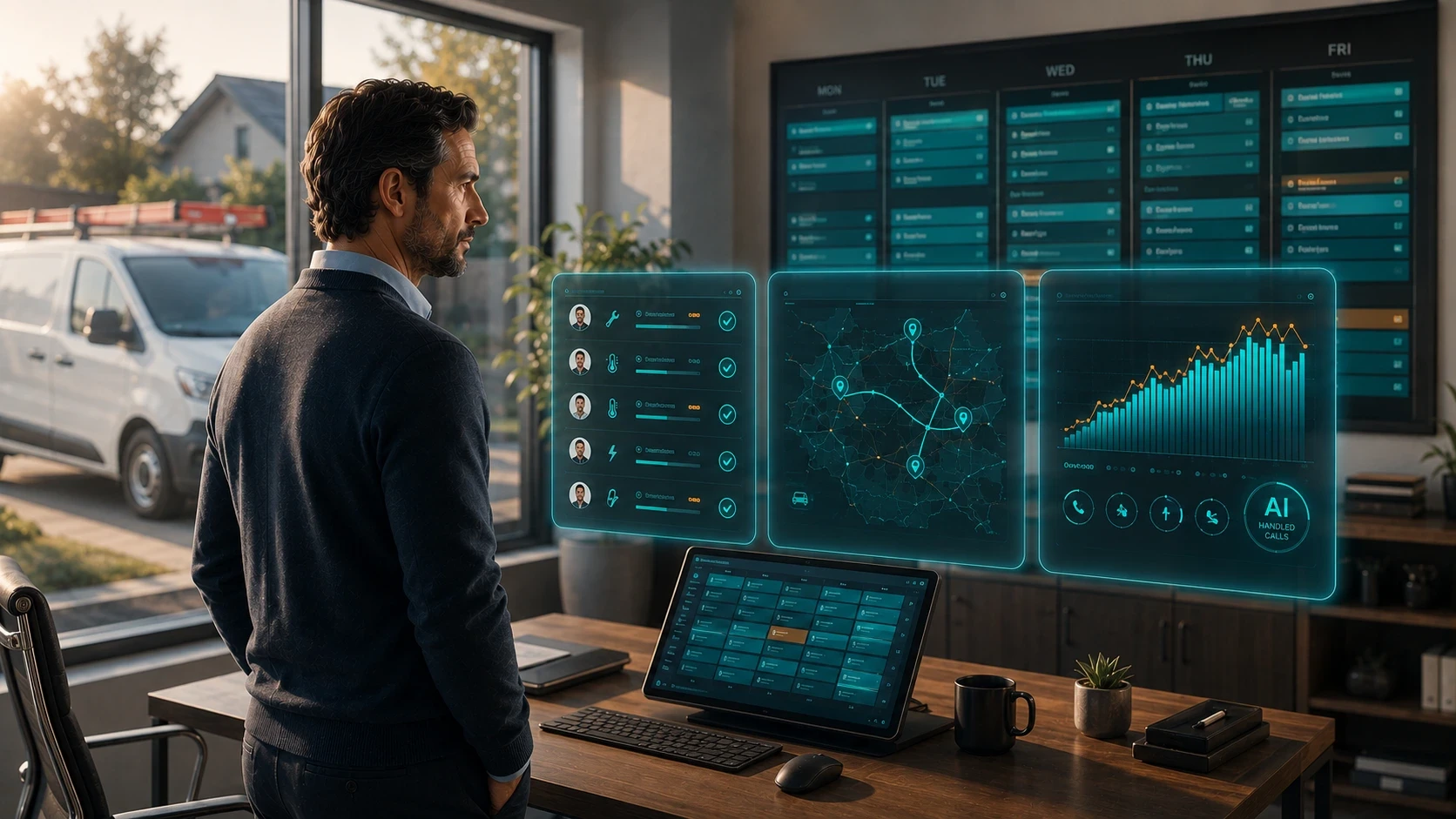
Article Summary: This article explains why home service businesses — HVAC companies, plumbers, electricians, landscapers, and similar trades — face a structurally inescapable call management problem: their most productive people are in someone's home all day and cannot answer the phone, while every missed call is a job that goes to a competitor. It maps six distinct call types against their urgency and AI handling protocol, calculates the annual revenue at risk from missed job requests, addresses emergency call triage as a specific safety-sensitive use case, and presents a realistic case study of a multi-technician HVAC company. Includes a call type triage table, revenue impact calculation, full comparison table, and implementation guide.
Key Highlights
• Home service businesses face a unique version of the missed call problem: the people who could answer the phone — the business owner, the lead technician — are physically inside a customer's home when the next job inquiry calls in. The phone rings, nobody answers, and the caller books a competitor.
• Every missed inbound call from a new customer is not a delayed booking — it is a lost job. Homeowners with an urgent need call two or three providers and book the first one who responds. They do not wait for a callback.
• Emergency calls — a burst pipe, a heating system failure in winter, an air conditioner out in a heat wave — arrive at night and on weekends precisely when most home service businesses have no coverage at all. These calls command premium rates and go entirely uncaptured without after-hours AI.
• Seasonal demand spikes create the same problem as a storm surge at a utility: a heat wave in July triggers dozens of HVAC calls simultaneously, while every technician is already on a job. A fixed-capacity phone system cannot handle the surge without hold times, dropped calls, and lost business.
• Voice AI answers every call type — emergency triage, new job booking, appointment changes, job status inquiries — 24/7, integrates with field service scheduling software, and routes true emergencies to an on-call technician immediately.
• For small home service businesses operated by the owner-technician directly, Voice AI is the operational equivalent of hiring a full-time dispatcher at a fraction of the cost — except it works nights and weekends.
Table of Contents
• Why Home Service Businesses Face an Inescapable Call Coverage Problem
• The On-the-Job Call Miss: Why the Most Valuable Calls Arrive at the Worst Moment
• The Seasonal Surge: When Every Technician Is Busy and the Phone Doesn't Stop
• The Six Types of Inbound Calls Every Home Service Business Handles
• The Annual Revenue at Risk from Missed Job Requests
• Emergency Call Triage: A Safety-Sensitive Boundary
• 7 Ways Voice AI Transforms Home Service Business Operations
• Case Study: A Multi-Technician HVAC Company During Peak Summer Season
• Owner Answering vs. AI Phone Agent: Side-by-Side Comparison
• How to Implement Voice AI at Your Home Service Business
• Common Mistakes Home Service Businesses Make with Call Management
• Best Practices for Home Service Voice AI
• Future Trends: AI in Field Service and Home Services
• Frequently Asked Questions
• Conclusion
Introduction
It is 2:30 PM on a Tuesday in July. An HVAC technician is halfway through replacing a condenser unit at a house in the suburbs. His phone rings. He cannot answer — his hands are inside the unit, it is 94 degrees, and the homeowner is standing three feet away waiting for the job to finish.
That call is from a family across town whose air conditioning stopped working last night. They have a toddler at home. They have already called two other HVAC companies. One sent them straight to voicemail. One said the earliest available slot was Thursday.
The second HVAC company that answered — a smaller firm with an AI phone agent — just booked them for 5 PM today. The call lasted 90 seconds.
The first technician's company will never know they missed that job. There is nothing in any system to tell them a potential customer called, got no answer, and hired a competitor within three minutes. No voicemail. No missed call log that connects to a lost revenue figure. Just a job that does not exist.
This scenario repeats itself dozens of times a week at every home service business that relies on the owner or technicians to answer the phone. The article explains exactly why this problem is structural — not a staffing failure or a lack of effort — and how Voice AI solves it without adding overhead, changing the technician's workflow, or requiring anyone to be at a desk.
Why Home Service Businesses Face an Inescapable Call Coverage Problem
Most industries covered in this series face a call management problem caused by volume: too many calls arriving faster than a fixed number of people can handle them. Home service businesses face something different. Their call problem is not primarily about volume — it is about where the team is when the phone rings.
A plumber cannot answer the phone while cutting through a wall to access a pipe. An electrician cannot step away from a live panel to take a quote request. An HVAC technician on a rooftop cannot manage a customer conversation while diagnosing a commercial unit. The job itself demands full physical attention, and the calls arrive precisely during the hours when every available person is doing exactly that.
For small home service businesses, the problem compounds because the owner is often also the most senior technician. They are answering calls when they are in the truck between jobs, but the moment they arrive at a site, the phone is off-limits. Every call that arrives during a job is a call with no one to answer it.
Research from Alliance Virtual Offices found that small businesses miss between 40% and 62% of incoming calls. For a field service business where the entire team is on-site during peak business hours, the missed call rate during those hours is likely at the top of that range or higher. The consequence is more direct than in most industries: a homeowner with a working furnace that just died is not going to wait for a callback. They are going to book the first trade professional who picks up.
The On-the-Job Call Miss: Why the Most Valuable Calls Arrive at the Worst Moment
The on-the-job call miss is the named recurring crisis for home service businesses. It is the equivalent of the restaurant dinner rush, the dental Monday morning surge, or the exhibition company's peak build week — a predictable, recurring window when call coverage is structurally impossible and the calls that arrive during it are the most valuable the business will receive that day.
Home service job requests follow a predictable daily pattern that lines up almost exactly with the working hours of the technician team:
• Morning calls arrive between 7 and 9 AM as homeowners discover problems before leaving for work — a boiler that didn't fire overnight, a faucet that started leaking during the morning routine
• Midday calls arrive between 11 AM and 2 PM, often from homeowners calling from work to arrange a repair at their home
• Afternoon calls arrive between 3 and 6 PM as people return home and discover problems they missed in the morning rush
All three of these windows coincide with the hours when every technician is on a job. The calls are not arriving when the truck is in transit or the owner is at the office. They are arriving when the entire team is unavailable.
The after-hours dimension compounds this. Emergency calls — a burst pipe at 10 PM, a heating failure at midnight in January — represent the highest-value, highest-urgency job requests a home service business receives, and without a 24/7 coverage system, they go entirely unanswered.
The Seasonal Surge: When Every Technician Is Busy and the Phone Doesn't Stop
Home service businesses experience seasonal demand spikes that amplify the on-the-job call miss into an operational crisis. For HVAC companies, the first significant heat wave of summer and the first cold snap of autumn each trigger a wave of calls from homeowners whose systems have not been used in months and are now failing. For plumbing businesses, a hard freeze generates simultaneous burst pipe emergencies across an entire service area.
During these windows, an HVAC company's technicians are fully committed from before 8 AM to after 6 PM. Every available slot is filled. Every technician is on a job. And the phone is receiving three, five, or ten times the normal daily call volume — most of them from new customers who found the business through Google and are calling their second or third choice because the first one didn't answer.
Unlike the storm surge at an electricity utility, which is a predictable event tied to weather, the home service seasonal surge happens annually and on a calendar that operators can anticipate. A well-configured Voice AI system that handles surge call volume during winter emergency heating calls can be set up and tested during the quieter spring months — well before the surge arrives.
The Six Types of Inbound Calls Every Home Service Business Handles
Home service phone calls fall into a clear and manageable pattern. The table below maps the six most common types against their urgency level, what the AI phone agent handles, and when the call must reach a human.
Call Type | Urgency / Volume | AI Phone Agent Handles | Routes to Owner / Tech When |
Emergency Service Request | HIGH - Immediate | Captures location, nature of emergency, and contact details; confirms an emergency technician will call back within a defined window; logs to dispatch queue with URGENT flag | Always for true emergencies — the AI captures and flags; a tech or dispatcher calls back immediately based on the configured emergency protocol |
New Job Request / Quote | HIGH - Direct Revenue | Captures customer name, address, type of work needed, and preferred appointment window; books the job directly into the scheduling system or schedules a callback from the office | Customer asks for a detailed on-site estimate requiring a technician's assessment before any price can be given |
Appointment Scheduling / Change | MEDIUM - High Volume | Books, reschedules, or cancels appointments directly in the field service platform; confirms the new time with the customer and sends a reminder | Customer has a very specific technician request or a complex scheduling constraint the system cannot resolve automatically |
Job Status Inquiry | MEDIUM - Daily Volume | Provides the estimated arrival window for today's appointment from the scheduling system; confirms if a technician is running late and provides an updated ETA | Customer reports a technician did not arrive, a job was done incorrectly, or has a complaint requiring management judgment |
Billing / Invoice Question | MEDIUM - Routine | Provides invoice total, payment due date, and accepted payment methods from the billing system; logs any dispute for the office to review | Customer disputes a charge, requests a refund, or raises a warranty claim on completed work |
General FAQ (Service Area, Hours, Pricing) | MEDIUM - Fully Automatable | Answers all general questions from the pre-loaded knowledge base instantly; never requires escalation | Essentially never — fully self-contained |
The pattern in this table makes the automation opportunity clear: five of the six call types can be handled entirely by a well-configured AI phone agent without any human involvement. The emergency call is the exception — not because the AI cannot take the information, but because a genuine home emergency always requires a human decision about dispatch. The AI's job in that scenario is to capture the situation completely and trigger the emergency response pathway immediately.
The Annual Revenue at Risk from Missed Job Requests
The financial impact of missed calls at a home service business is unusually direct. Unlike industries where a missed call might delay a transaction that eventually completes anyway, a missed job request at a home service business is almost always a permanent loss — the homeowner booked someone else within the hour.
The table below illustrates the annual revenue at risk for a mid-sized home service business. All figures are illustrative and should be replaced with the operator's own call volume and average job value data.
Metric | Calculation (Illustrative) | Result |
Inbound calls per day (business hours) | 20 calls | 20 calls |
Estimated missed call rate during field hours | 40% | 8 missed calls/day |
New job request rate among missed calls | 60% | ~5 missed job opportunities/day |
Average job value (mixed trade, illustrative) | $320 | — |
Daily revenue at risk from missed calls | 5 x $320 | $1,600/day |
Annual revenue at risk (250 working days) | $1,600 x 250 | $400,000/year |
After-hours emergency call value (additional) | Emergency jobs command premium rates; currently not captured at all without after-hours AI coverage | Not modelled — qualitative benefit |
Note: These figures are illustrative. Average job values vary significantly by trade, job type, and geography — a routine plumbing repair may be $150, while an HVAC system replacement may exceed $8,000. The $320 blended average used here is a conservative mid-range estimate for a general-trade home service business handling a mix of repair and installation work. Operators should use their own average ticket data for a business-specific calculation.
The annual figure above covers only daytime call losses during standard business hours. It does not include the value of after-hours emergency jobs — which carry premium rates and represent calls the business currently captures at exactly zero percent without evening and weekend coverage. For HVAC operators in particular, winter emergency heating calls are among the highest-margin jobs of the entire year.
Emergency Call Triage: A Safety-Sensitive Boundary
Home service emergencies — a gas leak, a burst pipe flooding a basement, an electrical burning smell, a heating failure with vulnerable occupants — are not just revenue opportunities. They are genuine safety situations that require a fast, reliable human response. This creates a boundary similar to the ones established in the pharmacy, medical, and utility articles in this series: the AI handles the intake and triage, but a human always handles the resolution.
The correct configuration for a home service emergency call is:
• The AI recognizes emergency language in the caller's description — flooding, gas smell, no heat in extreme cold, burning smell — and immediately shifts to the emergency intake flow
• It captures the caller's address, a precise description of the situation, and their contact number
• It does not attempt to troubleshoot or advise the caller on the emergency itself
• It immediately alerts the on-call technician or owner via SMS, with the full intake details, and commits to the caller that someone will call back within a specified time
• For situations involving potential gas leaks or fire risk, it also provides the caller with emergency services contact information as a parallel action
This triage logic must be designed with input from the business owner and tested thoroughly before go-live. An emergency call that is mishandled at first contact — routed to a general queue or given a next-day callback commitment — is a service failure with real consequences. When it is configured correctly, however, AI triage actually improves emergency response reliability compared to a system where the emergency call goes to voicemail at 11 PM.
7 Ways Voice AI Transforms Home Service Business Operations
Here is what a properly configured Voice AI system does for a home service business across the seven highest-impact use cases.
1. After-Hours and 24/7 Emergency Call Coverage
This is the use case with the highest immediate impact for most home service businesses. A homeowner whose boiler stops working at 9 PM on a Friday has three options: call an emergency plumber, call around hoping someone answers, or wait until Monday and spend a cold weekend. A business with 24/7 AI phone coverage converts that caller into a booked emergency job before they finish browsing Google.
The AI answers immediately with a professional tone, gathers the situation details, and commits to an emergency callback from the on-call technician — giving the homeowner the confidence that help is coming without requiring anyone to be awake monitoring the phone.
2. New Job Request Capture During Field Hours
When every technician is on a job and the owner cannot answer, new job requests go straight to voicemail — and the caller moves on. An AI phone agent captures these requests in real time, with structured information about the job type, address, and preferred timing, and books them directly into the scheduling system or queues them for the next available slot.
For a business using field service management software like ServiceTitan, Jobber, or Housecall Pro, this integration means new jobs appear in the schedule automatically. By the time the technician finishes the current job and checks the system, the next two appointments are already confirmed.
3. Seasonal Surge Overflow Handling
During a summer heat wave or a winter freeze, an AI phone agent absorbs the spike in simultaneous calls without any hold time or dropped calls. Every caller receives an immediate answer and a confirmed slot — even if that slot is two days out — rather than a busy signal that sends them to a competitor.
For peak-season calls where the schedule is genuinely full, the AI captures the caller's details and books them onto a wait-list with a callback confirmation for when a slot opens. This is consistently better than voicemail, where most callers do not leave a message and the business never captures the contact.
4. Appointment Confirmation and No-Show Reduction
A technician who drives to a property and finds no one home has wasted a slot that could have served a paying customer. AI-driven outbound confirmation calls the day before each appointment — confirming the window, the address, and any access details — reduce no-shows and give the customer a natural opportunity to reschedule if their plans have changed.
For businesses that charge a no-show fee or cancellation fee, the AI can confirm that policy during the reminder call, reducing disputes when the fee is applied.
5. Job Status and ETA Management
One of the most common and most time-consuming call types for a home service dispatcher is the customer asking when the technician will arrive. Integrated with the field service scheduling system, an AI phone agent can answer this question in real time — pulling the current job status and estimated completion time and providing the customer with an accurate arrival window without any human involvement.
This single capability alone can save a dispatcher thirty to sixty minutes of call time per day, which in a small business is a meaningful portion of their working hours.
6. Customer Recall and Maintenance Reminder Outreach
Most home service businesses have a large base of past customers who are overdue for routine maintenance — HVAC seasonal tune-ups, water heater inspections, gutter cleaning, pest prevention treatments. These customers are the easiest source of new revenue in the business, but the outbound calls to reach them never happen because the team is too busy handling inbound calls from new customers.
An AI phone agent running a systematic outbound recall campaign calls past customers at defined intervals, reminds them of their last service date, and books maintenance appointments directly. This is the home service equivalent of the dental recall programme — and like dental recalls, the ROI of running it consistently is significant.
7. CRM and Field Service Software Integration
Every AI-handled call — new job request, appointment change, emergency, status inquiry — is logged with complete, structured detail directly into the CRM and field service platform. Technicians start each day with a full schedule populated by AI-captured bookings, complete with job details and customer contact information, without any manual data entry from overnight or early-morning calls.
For businesses that track job sources for marketing purposes, AI-captured calls provide accurate attribution data — something that is nearly impossible to maintain reliably with manual call handling.
Case Study: A Multi-Technician HVAC Company During Peak Summer Season
Business profile: A residential HVAC company with six technicians, an office manager, and the owner-operator. The company serves a mid-sized metropolitan area and handles installation, repair, and annual maintenance contracts. Summer is the peak demand season, with the first significant heat wave typically arriving in late June and driving a three-to-four-week surge in repair calls.
The problem: During peak summer weeks, all six technicians are scheduled from 7 AM to 6 PM. The office manager handles calls but cannot manage simultaneous inbound volume during the surge. Between 10 AM and 4 PM — when every technician is at a job and the office manager is handling check-in calls and dispatching — new job request calls frequently go unanswered or to voicemail. The owner estimates that during a peak heat wave week, the business misses between 8 and 15 new job requests daily. Most of these callers book a competing HVAC company the same day.
Additional pain points:
• Weekend emergency calls during summer heat waves go entirely to voicemail after 5 PM Friday, with some customers not reached until Monday — by which point they have resolved the issue with a competitor or waited through a potentially dangerous heat weekend
• The office manager spends an estimated 90 minutes per day answering status and ETA calls from customers waiting for technicians — time that could otherwise go toward scheduling, invoicing, and dispatch coordination
• Annual maintenance reminder calls to the existing customer base happen sporadically, depending on the manager's availability, and the outreach is never systematic enough to fill slow-season schedule gaps reliably
The solution deployed:
VoxietyAI configured an AI phone agent integrated with the company's Jobber scheduling platform. New job requests are captured and booked automatically, including direct-to-calendar slot placement for same-day and next-day availability. Emergency calls received after 5 PM trigger an immediate SMS alert to the on-call technician with the caller's address and situation description. Customer status and ETA calls pull directly from the live schedule. A systematic annual maintenance outbound campaign runs from the customer database throughout the slower winter months.
Results after the first full summer peak season with AI phone coverage:
• New job capture rate during peak hours: Increased substantially, with the company attributing a measurable increase in confirmed summer bookings to calls that would previously have gone to voicemail during the 10 AM to 4 PM field window
• Weekend emergency coverage: Every after-hours emergency call now reaches the on-call technician within minutes; the company completed three weekend emergency jobs in the first month of deployment that it would previously not have known about until the following Monday
• Office manager ETA call time: Reduced by an estimated 60-75 minutes per day as status and arrival window calls are handled directly by the AI from the live schedule
• Annual maintenance rebooking: The systematic outbound campaign in the following winter filled an estimated 22 additional maintenance slots in January and February — traditionally the company's slowest months
Note: These results reflect a realistic scenario based on outcomes home service businesses can expect from implementing voice AI. Individual results depend on call volume, trade type, geographic market, and system configuration.
Owner / Office Staff Answering vs. AI Phone Agent: Side-by-Side Comparison
Function | Owner / Office Staff Answering | AI Phone Agent |
Call Hours | Business hours only; owner unavailable when on a job | 24/7 including evenings, weekends, and public holidays |
Emergency Call Coverage | Voicemail or missed entirely after hours | Immediate triage, flag, and tech callback protocol |
New Job Booking | Manual; missed when owner is on-site | Captured and booked 24/7, directly into scheduling system |
Seasonal Surge Handling | Hold times; calls dropped; owner overwhelmed | Unlimited simultaneous calls; surge absorbed automatically |
Job Status / ETA Inquiries | Owner calls tech for update, relays to customer | AI pulls live ETA from scheduling system; no human chain needed |
Billing FAQ | Owner handles manually; interrupts fieldwork | AI answers from billing system and pre-loaded FAQ |
CRM / Job Data Entry | Manual after every call; often forgotten | Automatic and structured during the call |
Consistency of First Impression | Varies by how stressed or busy owner is | Identical professionalism on every call |
How to Implement Voice AI at Your Home Service Business
Implementation at a home service business is more straightforward than in most industries covered in this series, because the call types are well-defined and the scheduling integration path is clear. Here is a step-by-step guide.
Step 1: Map your call types and current missed call rate. Review three months of call logs, if available, to understand your actual inbound call volume, the breakdown by call type, and your best estimate of how many calls are missed during field hours. If you do not have this data, track manually for two weeks. This baseline determines the size of the revenue opportunity you are addressing.
Step 2: Define your emergency call protocol. Before any configuration work begins, document exactly what constitutes an emergency for your business, who the on-call contact is at different hours, and what response window you are committing to. This becomes the foundation for the AI's emergency triage logic and must be approved before go-live.
Step 3: Integrate with your field service scheduling software. Connect the AI to your scheduling platform — Jobber, ServiceTitan, Housecall Pro, or equivalent — so that new job requests can be booked directly and job status inquiries can pull live data. This integration is what makes the AI genuinely useful rather than a sophisticated message-taking service.
Step 4: Build your service area and service type knowledge base. Document every service you offer, your service area by zip code or neighborhood, your standard pricing ranges where you are comfortable sharing them, your hours, and any notable specializations. This becomes the foundation for FAQ handling and ensures the AI does not quote prices or commit to services outside your offering.
Step 5: Configure the seasonal surge calendar. If your trade has predictable demand peaks, pre-configure how the AI handles a full schedule — offering the wait-list, setting expectations for wait times honestly, and capturing caller details for follow-up — before the surge arrives. Testing this during a quiet period avoids discovering configuration gaps when you need the system most.
Step 6: Test every call type personally before going live. Call your own AI from a customer's perspective — as a new job request, as an emergency, as a status inquiry, as a billing question, and as someone asking about your service area. The emergency scenario is the most important test: confirm that the triage correctly escalates, the on-call SMS is sent, and the caller receives an appropriate commitment.
Step 7: Brief your team on what callers experience. Technicians receiving escalated emergency SMS alerts should understand exactly what information they will receive and what their response commitment is. The dispatcher or office manager should understand which calls the AI is handling autonomously and which are reaching them, so they can follow up with full context.
Common Mistakes Home Service Businesses Make with Call Management
These are the most common errors home service operators make with their phone systems, with or without AI.
Treating voicemail as an adequate after-hours solution. Most homeowners with an urgent service need do not leave voicemails. They call the next number. A voicemail box that collects three messages overnight captures a fraction of the calls that could have become confirmed jobs.
Not having an emergency protocol defined before deploying AI. An AI that handles an emergency call with the same response as a routine appointment request is a serious service failure. The emergency pathway must be designed, approved, and tested before the system handles a real emergency call.
Deploying without field service software integration. An AI that cannot book appointments directly into the scheduling system requires the owner or office manager to manually enter every AI-captured booking. The integration removes this double-handling and is the primary driver of operational efficiency.
Not running a systematic customer recall programme. Most home service businesses have a past customer base that represents their easiest source of new revenue. The AI outbound recall capability is one of the highest-ROI features available, but it is frequently left unconfigured while the operator focuses on inbound call handling.
Giving the AI outdated service area or pricing information. A customer who is told by the AI that the business serves their area, then told by a human that it doesn't, has had their time wasted and their trust eroded. The AI knowledge base must reflect the business's actual current service area, current pricing structure, and current availability.
Best Practices for Home Service Voice AI
These practices consistently improve outcomes for home service businesses implementing Voice AI:
• Set the emergency callback commitment at a time you can reliably meet. If your on-call technician can realistically call back within 30 minutes at midnight, commit to that. If they need 60 minutes, commit to 60. A specific commitment honored is far better than a vague "someone will call you back" that may not happen for two hours.
• Configure the AI's tone to match your brand. A premium home service company known for white-glove service should sound different from a budget repair shop. The AI is the first impression for every caller who reaches out outside business hours — it should reflect how you want to be known.
• Review new job bookings captured overnight every morning. Build a daily discipline of reviewing AI-captured overnight bookings before the first technician leaves the yard. Confirm ETAs, check for any unusual requests, and ensure nothing was flagged incorrectly.
• Track the revenue value of AI-captured jobs separately. Run a simple weekly report on the dollar value of jobs booked through AI calls versus human-answered calls. This data is your clearest measure of ROI and helps make the business case for expanding the system's capabilities.
• Update the knowledge base whenever you add a new service or change your service area. This should be a standing item in your onboarding checklist whenever the business changes what it offers. An outdated knowledge base is the most common cause of AI-related customer complaints in home service deployments.
Future Trends: AI in Field Service and Home Services
The application of AI to home service and field service operations is expanding well beyond phone call handling. Here is where the technology is heading.
AI-driven job routing and technician matching. Beyond capturing a new job request, AI systems will increasingly recommend which technician to assign based on location, skill set, current route, and historical completion rates — reducing dispatch time and improving first-visit fix rates.
Predictive maintenance outreach. Using historical job data, AI will identify which customers are statistically most likely to need service within the next 90 days — whether based on equipment age, last service date, or seasonal patterns — and reach out proactively before the system fails and the customer calls a competitor.
Integrated parts ordering workflow. When a technician on-site identifies a needed part, AI systems will automate the parts order, confirm the lead time, and communicate the updated job completion timeline to the customer — without the technician needing to call the office.
Voice AI for technician-to-customer communication. AI agents will increasingly handle the communication loop between the technician and the waiting customer — sending automated en-route notifications, adjusting ETAs based on real-time traffic, and collecting post-job satisfaction feedback — without requiring the technician to stop work to send messages.
Home service businesses that establish their Voice AI infrastructure now — with scheduling integration, emergency protocols, and recall outreach already running — will be best positioned to extend these capabilities as they mature.
Frequently Asked Questions
Can an AI phone agent handle a homeowner calling about a potential gas leak or flooding emergency?
Yes — but only if it has been specifically configured for that scenario with a well-defined emergency protocol. An AI handling a gas leak or flooding emergency should recognize the urgency, immediately capture the address and caller's contact details, and simultaneously alert the on-call technician via SMS while giving the caller a committed callback time. For life-threatening situations — a strong gas smell inside an occupied building — the AI should also provide the caller with the gas company's emergency line and advise them to leave the building. It should never attempt to troubleshoot the emergency itself. This configuration must be built, reviewed by the business owner, and tested against realistic emergency call scenarios before the system goes live.
What field service software platforms does Voice AI typically integrate with?
Voice AI systems that integrate with field service management platforms can typically connect with widely-used tools in the home service industry. At the time of writing, commonly integrated platforms include Jobber, ServiceTitan, Housecall Pro, and simpler calendar-based systems. The specific integrations available depend on the AI provider and the platform's API capabilities. Organizations should confirm specific platform compatibility with VoxietyAI during the scoping process rather than assuming compatibility based on general descriptions. Integration capability is the most important technical question to resolve before committing to a deployment.
Is Voice AI cost-effective for a solo operator or a very small home service business with just one or two technicians?
For solo operators and very small businesses, the value calculation is different from a larger team but the case is often stronger, not weaker. A solo plumber or electrician who is on-site all day and has no office staff answering calls is currently missing the maximum possible share of their inbound call volume — there is simply nobody available to answer between the first job of the day and the last. Voice AI is the operational equivalent of a part-time dispatcher for this operator, at a subscription cost that is typically a fraction of even a few hours of part-time staffing per week. The primary question is whether the scheduling integration is compatible with how the business currently manages its bookings. For businesses using a simple calendar or manual scheduling, configuration is straightforward. For businesses with no current scheduling system, the AI deployment is often a good prompt to adopt a basic field service platform at the same time.
Conclusion
Home service businesses lose revenue every day to a problem that is not caused by a lack of skill, effort, or customer demand. It is caused by the simple, unavoidable fact that the best people in the business are inside someone's home doing the work — and the phone rings while they are there.
Voice AI removes that constraint entirely. It answers every call, books every willing customer, routes every emergency to the right technician immediately, and builds the schedule while the team is busy filling it. For a solo operator, it is a full-time dispatcher who never takes a day off. For a multi-technician team, it is the infrastructure that turns a seasonal surge from a missed revenue event into a fully captured pipeline.
If your home service business is ready to stop losing jobs to the voicemail box and start capturing every call that arrives while your team is doing the work they are best at, VoxietyAI can build a system tailored to your trade, your scheduling platform, and your emergency protocol. Book a discovery call today.
Suggested External Sources (US and European)
https://www.phccweb.org/ (PHCC - Plumbing-Heating-Cooling Contractors Association)
https://www.acca.org/ (ACCA - Air Conditioning Contractors of America)
https://www.neca.org/ (NECA - National Electrical Contractors Association)
https://www.fsb.org.uk/ (Federation of Small Businesses - UK home services and trades data)
https://www.salesforce.com/blog/digital-customers-research-blog/